Elon Musk Wants Universal High Income. But Who Will Own the AI Behind It?
Elon Musk envisions Universal High Income powered by AI. Why AI ownership matters and how Action Model plans to share AI value with its contributors.
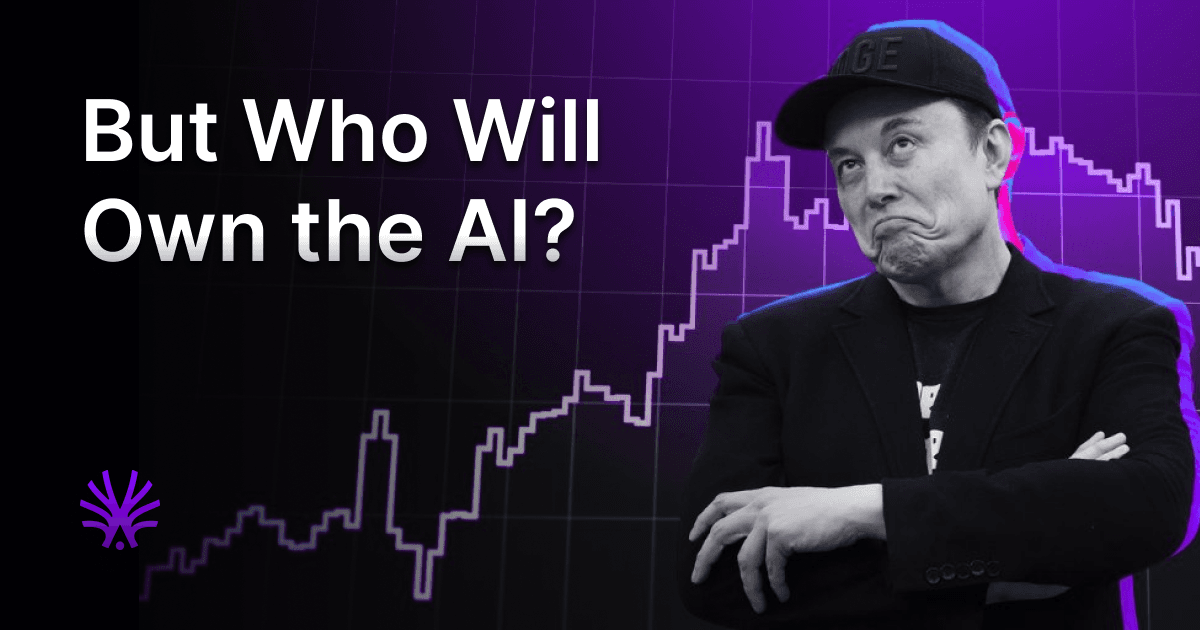
Elon Musk imagines a future where AI and robotics produce enough wealth for everyone to enjoy a comfortable life, even as machines perform more economically valuable work.
He calls it universal high income. On April 17, 2026, he wrote:
“Universal HIGH INCOME via checks issued by the Federal government is the best way to deal with unemployment caused by AI.”
The proposal addresses a fundamental challenge: if employment becomes a less reliable source of income, people will need another way to access the economy’s wealth.
Unlike universal basic income, which generally provides a regular, unconditional payment, Musk’s vision anticipates widespread material abundance. AI expands production, and government payments give people purchasing power.
It’s an exciting vision. But for it to work, both parts must succeed.
Musk argues that AI-driven production could outpace growth in the money supply, preventing inflation. That remains a prediction. Cheaper software cannot immediately expand housing, electricity networks or healthcare capacity.
Larger payments improve living standards only if essential goods and services remain accessible.
Funding and timing also matter.
Workers could face reduced opportunities before productivity gains make essentials cheaper. A credible programme needs sustainable funding and support during that transition.
In May 2025, the ILO and NASK estimated that 25% of global employment was potentially exposed to generative AI, rising to 34% in high-income countries.
They considered job transformation more likely than complete replacement.
Anthropic’s March 2026 research found no systematic unemployment increase among highly exposed workers since late 2022, but tentative evidence of slower hiring into exposed occupations among people aged 22 to 25.
These findings do not establish mass displacement, but they highlight why economic opportunity matters alongside unemployment.
And even if AI delivers extraordinary productivity, who actually benefits from that productivity remains a separate question.
A business reducing costs through automation could lower prices, reward employees or retain more profit for shareholders.
Competition, policy and ownership influence who benefits.
This brings us to a much bigger question: Who will actually own the wealth AI creates?
Universal High Income Is One Solution. Ownership Is Another.
Income support can provide financial security.
Ownership can give people a continuing stake in the assets producing that wealth.
And increasingly, even the world’s biggest AI companies are beginning to acknowledge the importance of sharing AI’s economic upside.
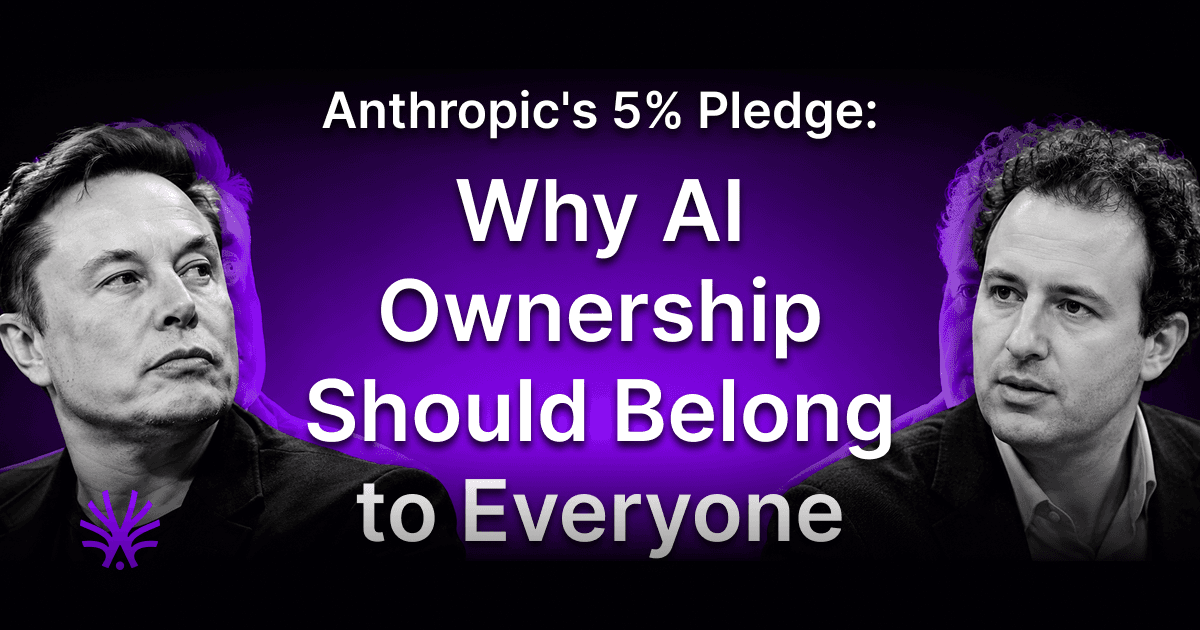
On October 18, Anthropic proposed allocating 5% of its shares to a Public Benefit Fund, subject to shareholder approval.
Additional allocations of two percentage points could follow each 50% valuation increase above a baseline, at the board’s discretion. Including earlier commitments, roughly 20% of shares could be dedicated to public benefit.
The fund could support nonprofits or selected populations. Its governance details remain forthcoming.
This could fund valuable work, but it does not automatically give the people contributing to AI personal ownership of the company.
On October 19, Musk pledged one SpaceX share to every child in America in 2027.
This proposes an individual asset, but remains undelivered and differs from recurring income for everyone.
OpenAI’s 2026 policy paper also proposes a Public Wealth Fund investing in diversified assets and potentially distributing returns to citizens.
These approaches deserve recognition.
But they leave a bigger question unanswered.
Why should people have to wait for billionaires and corporations to decide how much of AI’s wealth to share?
What about giving people the opportunity to own a piece of the AI they’re helping create in the first place?
AI Is Being Built With Human Contributions
There’s something missing from much of the discussion around AI-generated wealth.
AI doesn’t become intelligent in isolation. It learns from us.
Human knowledge, demonstrations and feedback help make AI useful.
People create the information AI learns from, correct its mistakes and demonstrate how tasks should be completed.
And as AI becomes increasingly capable of operating computers, human actions and workflows are becoming another valuable contribution.
Every click, decision and workflow can help teach AI how humans actually navigate websites, use software and complete real-world tasks.
Someone demonstrating how to reconcile an invoice, manage an account or complete a complex process is providing valuable knowledge.
That contribution can help make AI systems more capable and commercially valuable.
Yet the people providing this knowledge rarely receive an ongoing stake in the technology they’re helping improve.
Millions of people contribute to AI’s development, while most of the economic upside remains concentrated among a handful of companies and their shareholders.
This is exactly what we believe needs to change.
Action Model: Building AI That People Can Own
Our goal is to give people an opportunity to own a piece of the AI ecosystem they’re helping train and build.
This is different from traditional corporate share ownership, and the rights associated with $LAM depend on the final token terms.
But the principle is simple.
The people helping create AI’s value should have the opportunity to share in it.
Rather than waiting until AI generates enormous wealth and hoping that governments or billionaires distribute some of it, we believe people should have a path to participate in that value from the beginning.
Contributor ownership cannot replace universal economic protections. It can, however, broaden how people participate in AI’s value as the technology develops.
The Future of AI Should Benefit Everyone
Elon Musk’s vision of Universal High Income could represent an extraordinary future.
A world where AI creates unprecedented prosperity, people have greater financial security and technology improves living standards for everyone.
That’s a future worth working towards.
But greater AI productivity does not automatically mean greater prosperity for everyone.
If ownership remains concentrated, the wealth generated by AI could flow disproportionately to a small number of companies and billionaires.
And the people whose knowledge, data and behaviour helped create that intelligence could be left watching from the sidelines.
We believe there’s a better way.
Universal High Income asks how people will share in tomorrow’s prosperity.
Community ownership asks why people shouldn’t have the opportunity to own a share of the AI creating that prosperity today.
At Action Model, we’re building towards a future where the people helping create AI’s value have the opportunity to participate in it.
Because if AI becomes one of the most valuable technologies humanity has ever created, humanity should have the opportunity to share in that value.
Not just a handful of billionaires.
Explore Action Model and join our community-owned AI movement →
Sources: Forbes · ILO · Anthropic research · Anthropic, Public Benefit Fund · OpenAI, Industrial Policy for the Intelligence Age