Anthropic Is Giving 5% of Its Shares to Public Benefit. Here’s Why That’s Not Enough.
AI is being built with the contributions of millions of people. So why should almost all of its ownership remain in the hands of a few?
Something interesting is happening in the AI industry.
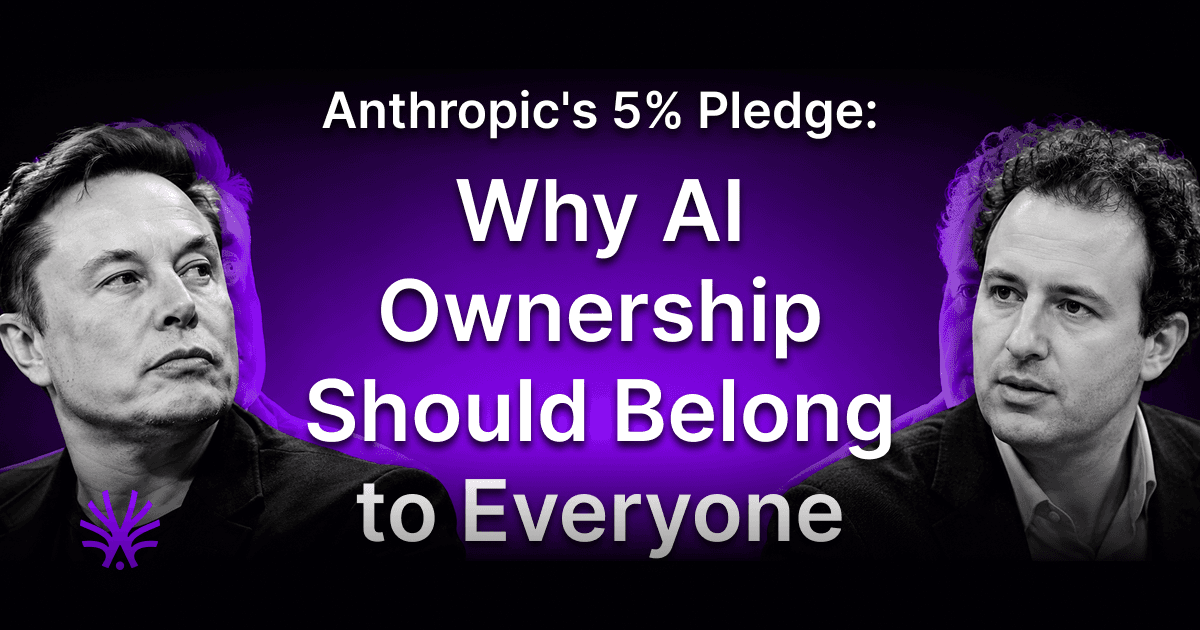
Anthropic has announced plans to dedicate 5% of its shares to public benefit.
Elon Musk has responded by suggesting shares should go directly to the public, before pledging to give one SpaceX share to every child in America next year.
These are significant announcements from some of the most influential people and companies in technology.
But they also highlight a much bigger problem.
The people helping create AI’s value are still largely excluded from owning it.
And at Action Model, we believe that needs to change.
Anthropic’s 5% Pledge: A Step Forward, But Not Far Enough
On October 18, Anthropic announced the creation of its Public Benefit Fund.
Subject to shareholder approval, the company plans to commit 5% of its shares to the fund, with the possibility of adding another two percentage points for every 50% increase in company value, at the board’s discretion.
Combined with existing founder and employee commitments, Anthropic says roughly 20% of its shares could ultimately be dedicated to public benefit.
The fund could support nonprofits, research and potentially direct distributions to selected populations.
It’s a meaningful commitment.
But there’s an important distinction.
Giving shares to a fund that benefits the public is not the same as giving the public ownership.
The people who contributed data, knowledge and feedback that helped make AI valuable don’t automatically receive equity or ownership rights.
They remain beneficiaries of whatever the fund eventually decides to distribute.
And that raises an important question:
Why should the public depend on billionaires deciding how much of AI’s wealth to give back?
Elon Musk Wants to Give Shares Directly to People
Elon Musk responded to Anthropic’s announcement with a simple suggestion:
“I recommend giving the shares directly to the public.”
He subsequently pledged to give one SpaceX share to every child in America in 2027.
If fulfilled, the initiative could distribute shares worth billions of dollars.
The details of eligibility and implementation still matter, and the pledge has yet to be delivered.
But the broader idea is significant.
Instead of simply donating money on behalf of the public, what if people actually owned a piece of the companies creating tomorrow’s wealth?
It’s a fundamentally different approach to distributing economic value.
And it’s a conversation the AI industry needs to have.
AI Could Create Unprecedented Wealth. But Who Will Own It?
AI is advancing towards a future where machines could perform an increasing share of the work humans do today.
Entire industries could be transformed.
Businesses could become dramatically more productive, and AI could create enormous economic value.
Some technology leaders envision a future of universal high income, where AI-generated prosperity allows people to enjoy a much higher standard of living without depending on traditional employment.
It’s an exciting possibility.
But there’s a problem with assuming everyone will automatically benefit.
AI becoming more productive doesn’t mean the wealth it creates will be shared.
If a handful of corporations own the models, infrastructure and businesses generating that wealth, they could capture a disproportionate share of the upside.
Meanwhile, millions of people whose knowledge, data and work helped make those systems possible might receive very little.
AI could make humanity wealthier than ever while concentrating more wealth and power in fewer hands.
That is not an inevitable outcome.
It’s a question of how we choose to build and own the technology.
AI Doesn’t Become Intelligent Without Humans
There’s something missing from much of the conversation around AI ownership.
AI is learning from us.
From the content people create.
From the knowledge they share.
From the feedback they provide.
And increasingly, from the way they interact with computers.
Human contributions have played an essential role in making AI useful.
As AI evolves beyond generating text and begins performing real-world tasks, another form of human knowledge becomes increasingly valuable:
Our actions and workflows.
Think about someone completing a complex task across multiple websites.
They know which buttons to click, which information matters, how to make decisions and what to do when something goes wrong.
That knowledge is incredibly valuable for training AI systems capable of performing those same tasks.
Yet today, much of the economic upside from AI development remains concentrated among the companies building and owning the models.
People contribute the intelligence. Companies capture most of the value.
We believe there’s a better way.
Action Model: Building AI That the Community Can Own
At Action Model, we’re building a different kind of AI ecosystem.
One where the people helping create the value have the opportunity to own a share of it.
We’re developing a community-owned Large Action Model (LAM) designed to understand how humans interact with websites, software and applications.
Through the Action Model browser extension, people can choose to contribute real-world actions and workflows that help train the model.
These contributions help AI learn how humans actually use computers, not just how humans communicate through text.
And instead of treating contributors as an invisible source of training data, we want them to participate in the value they’re helping create.
Our participation model rewards contributions with LAM Points, with conversion into $LAM tokens planned as part of our token generation event.
These tokens are different from traditional corporate shares, and their ownership rights and economic utility depend on the ecosystem’s final terms.
But the principle behind our approach is clear.
The people who help build AI should have a meaningful opportunity to share in its success.
Not as an occasional charitable donation.
Not solely because a billionaire decides to give something away.
But through a model where participation and contribution are part of how value is distributed from the beginning.
That’s the future we’re working towards.
The Future of AI Should Belong to More Than a Few Billionaires
Anthropic’s pledge and Elon Musk’s proposed share distribution are signs that the conversation around AI wealth is changing.
And that’s a positive development.
But we shouldn’t confuse generosity with a fundamental change in ownership.
A public benefit fund can do valuable work.
A share giveaway can provide people with an asset.
Neither automatically creates a system where the millions contributing to AI’s development have an ongoing opportunity to participate in the value they create.
We need to think bigger than how billionaires distribute AI wealth after they’ve accumulated it.
We need to think about how that wealth is created, who contributes to it and who gets to own it in the first place.
At Action Model, we believe AI can become one of the most transformative technologies humanity has ever created.
We want AI to become more capable, more useful and more accessible.
But as AI becomes more powerful, the people it serves should have the opportunity to become more economically empowered too.
AI should not make a handful of billionaires unimaginably wealthy while everyone else watches from the sidelines.
If millions of people help create AI’s value, millions should have the opportunity to share in it.
AI is inevitable. Concentrated ownership doesn’t have to be.
→ Join the Action Model Movement.
Sources: Anthropic, Public Benefit Fund · The Next Web